AI FOMO: Everyone Is Mastering AI Except Me — Or Are They?
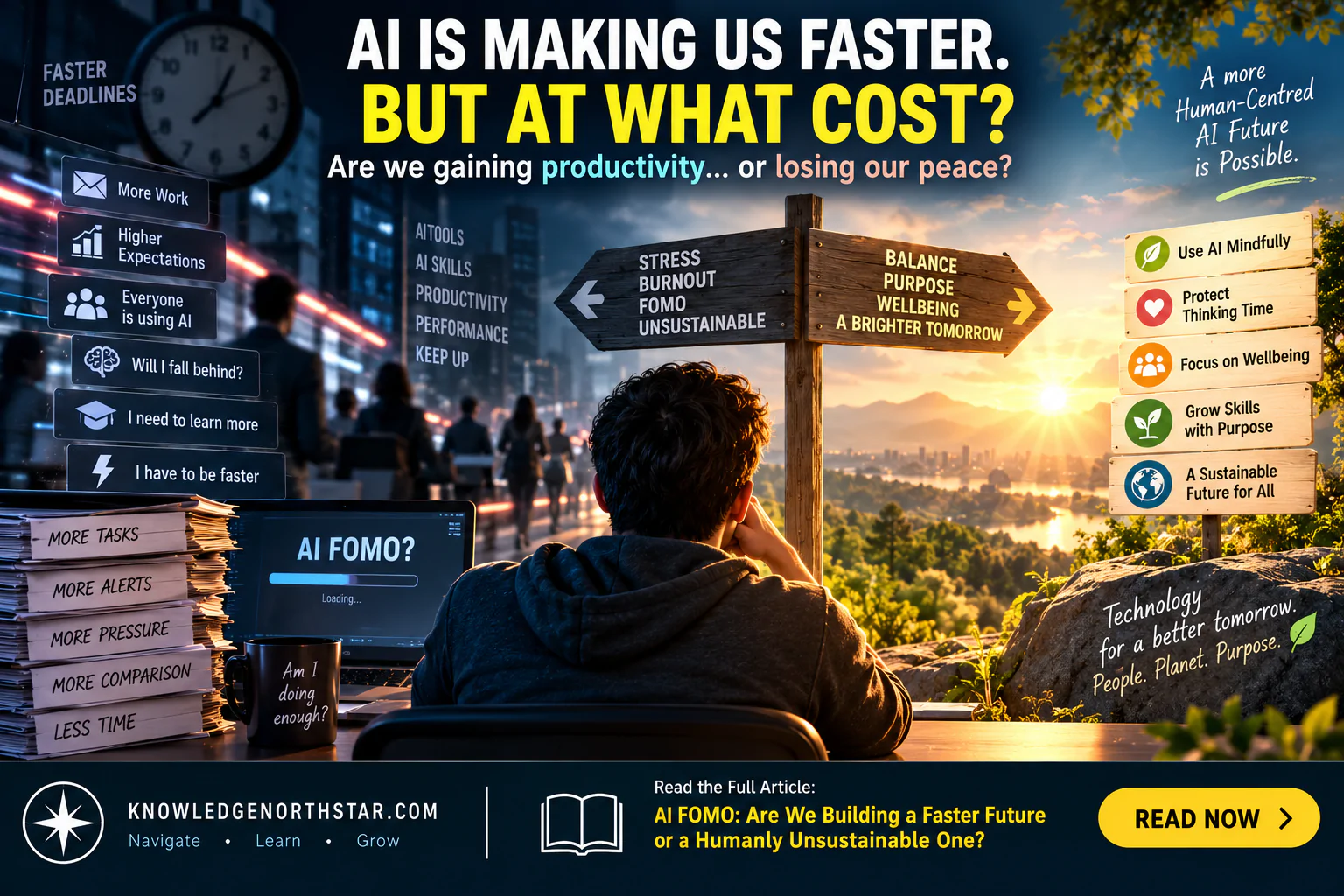
“The hidden impact of AI anxiety, productivity pressure and the race toward a humanly sustainable future.”
AI Is Making Us Faster. But Are We Becoming Too Fast?
We are living through one of the fastest technology transformations in human history.
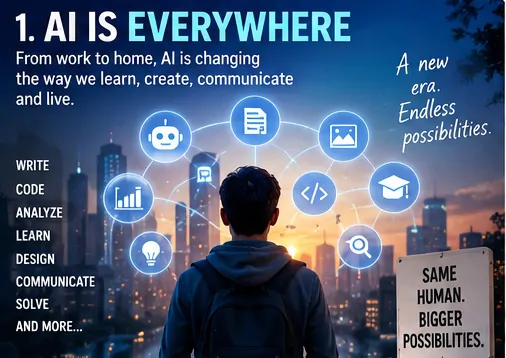
Artificial Intelligence is no longer something we simply read about. It is becoming part of how we write, code, analyse, design, communicate, learn, make decisions , improve decision intelligence and do our everyday work.
The message everywhere is simple:
Use AI. Become faster. Become smarter. Become more productive. Don’t get left behind.
But this raises another important question:
Is the AI revolution creating a new kind of pressure on humans, the pressure to constantly move faster?
And perhaps even more importantly:
Are we creating AI FOMO while trying to create an AI-powered future?
Recent research suggests that these concerns are not just hypothetical.
What Is AI FOMO?
We already know the term FOMO — Fear of Missing Out.
Traditionally, it was associated with social media: Everyone is attending the event, everyone is travelling, everyone is having fun—and I am missing something.
AI is creating a different version:
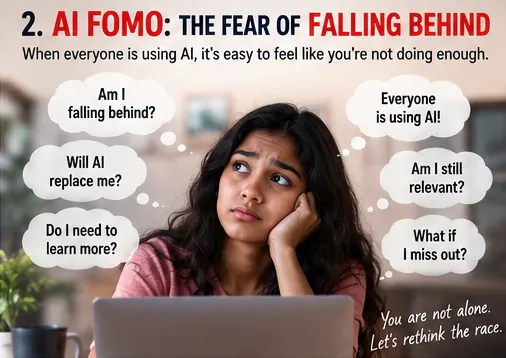
AI FOMO — Fear of Falling Behind in the AI Revolution.
Imagine this situation. Your colleague uses AI to prepare a report in 30 minutes. Someone else uses AI to write code faster. Another person uses AI to analyse hundreds of documents. Someone is experimenting with AI agents. Someone else has completed an AI certification. And suddenly, you start asking yourself:
“Am I becoming slower?”
“Do I need to learn AI immediately?”
“Will my skills become outdated?”
“Will someone using AI replace me?”
“Am I doing enough?”
That is where AI adoption can move from opportunity to psychological pressure.
A 2026 study specifically examining AI FoMO in the workplace found that concerns about skill devaluation, reduced autonomy and AI-based supervision can contribute to employees’ fear of being left behind.
Another 2026 study involving 442 new employees found that workplace FoMO in an AI-driven environment can create adaptation pressure.
So the question is no longer simply:
“Will AI change our jobs?”
It is also:
“How will our perception of AI change us?”
The Productivity Paradox of AI
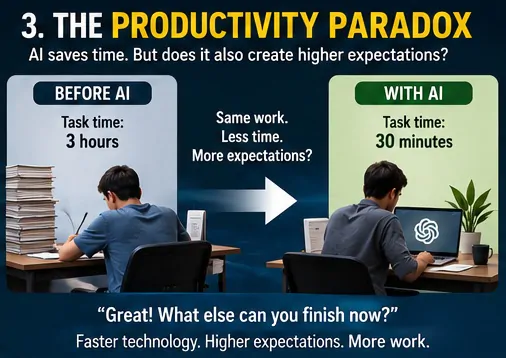
Here is where things become interesting. AI is designed to save time. But saving time can unintentionally create higher expectations. Suppose a task previously required three hours. AI helps you complete it in one hour. That’s wonderful. But what happens next?
Instead of saying:
“You saved two hours. Take a break.”
We may start saying:
“Great. What else can you finish in those two hours?”
And this cycle continues.
Faster technology → higher expectations → more work → greater pressure → demand for even faster technology.
This could become the AI productivity paradox. AI may reduce the time required for individual tasks while simultaneously increasing the amount of work humans are expected to accomplish.
Is AI Making Our Brains Work Faster?
We need to be careful here. There isn’t enough evidence to say that AI is literally making the human brain operate faster. But research is beginning to show something equally interesting:
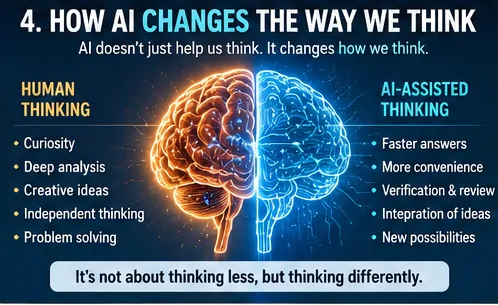
AI is changing how we think.
A 2025 CHI study by researchers from Carnegie Mellon University and Microsoft Research surveyed 319 knowledge workers and collected 936 real-world examples of generative AI use. The researchers found that higher confidence in AI was associated with less reported critical-thinking effort. They also found that AI shifts critical thinking toward activities such as verifying information, integrating AI responses and overseeing tasks.
This doesn’t mean AI is “making us stupid.”. It means our cognitive workload is changing. We may spend less time creating something from scratch and more time:
- Checking AI-generated information
- Improving prompts
- Reviewing outputs
- Making decisions
- Integrating multiple AI responses
- Taking responsibility for the final result
The human role isn’t disappearing. It is evolving.
AI Technostress: The Hidden Cost of AI Adoption
There is another term we should pay attention to: AI technostress. Technostress refers to stress created by the demands of technology. And AI can amplify this pressure.
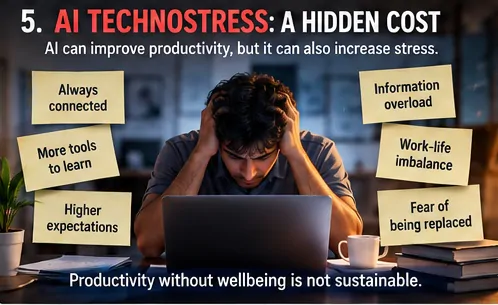
A 2025 study involving 600 employees across different industries found that AI technostress was associated with greater exhaustion, work-family conflict and lower job satisfaction—even while AI could improve productivity. This creates an uncomfortable contradiction:
AI can make us more productive and more stressed at the same time.
That is something organizations need to take seriously. Because productivity without wellbeing is not sustainable productivity.
Are We Forgetting Human Sustainability?
We talk extensively about AI sustainability—and rightly so. Much of the conversation focuses on the environmental impact of AI, including its growing energy consumption, carbon emissions, water usage, e-waste, and the environmental footprint of data centers. These are critical issues that deserve our attention as AI adoption continues to accelerate.
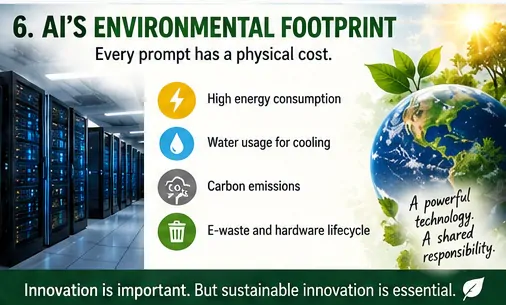
But there is another dimension of sustainability that deserves equal attention: human sustainability.
Can humans sustainably operate at the same speed at which we expect technology to operate?
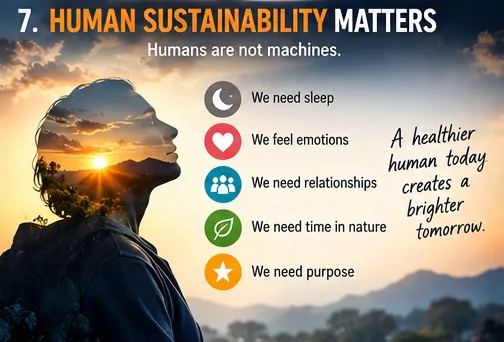
A computer can process information continuously. Humans cannot.
AI doesn’t need sleep. Humans do.
AI doesn’t experience burnout. Humans do.
AI doesn’t need time with family, friends, or nature. Humans do.
As AI becomes faster, smarter, and more capable, we must be careful not to create a world where humans are expected to match the pace of machines.
The goal of technology should not be to make humans behave more like machines.
The goal should be to use machines to give humans more space to be human.
That, too, is sustainability.
So, What Is the Solution?
The answer isn’t to slow down AI. And it certainly isn’t to reject AI. The answer is to build a more human-centred AI culture.
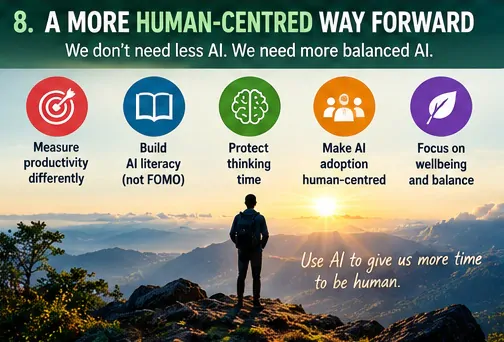
1. Measure productivity differently
Don’t measure AI success only by:
“How much faster did we complete the task?”
Also ask:
“What did we do with the time we saved?”
- Did employees learn?
- Innovate?
- Think?
- Collaborate?
- Spend time with customers?
- Or did we simply fill the saved time with more work?
2. Replace AI FOMO with AI literacy
Employees shouldn’t feel:
“I need to learn every new AI tool immediately.”
Instead, organizations should help people understand:
- Which AI tools matter for my role?
- Where should I use AI?
- Where should I not use AI?
- How do I verify AI output?
AI literacy should be about confidence and judgment, not chasing every new trend.
3. Protect thinking time
Not every problem needs an AI-generated answer. Sometimes humans need to:
Think. Question. Explore. Fail. Reflect.
Organizations should deliberately create space for independent thinking. Because if AI does all the thinking before humans even attempt to think, we may save time today but weaken important capabilities tomorrow.
4. Make AI adoption human-centred
AI implementation should consider more than ROI. Organizations should measure:
- Productivity
- Employee wellbeing
- AI-related stress
- Learning and skill development
- Work-life balance
- Employee autonomy
- Quality of decision-making
In other words:
Don’t just ask, “Can AI do this?”
Ask:
“Should AI do this—and what happens to the human if it does?”
The Future Should Not Be Humans vs AI
AI is an extraordinary technology. It can help us solve problems faster, discover patterns, automate repetitive work and tackle challenges that were previously difficult to address. But we should not allow AI productivity to become a race against ourselves. The real measure of successful AI adoption should not be:
How fast can humans become?
It should be:
How much better can humans live, think, create and solve problems with AI?
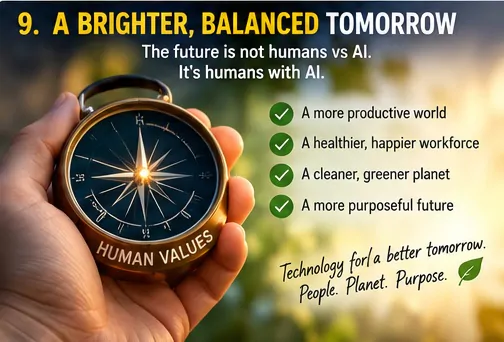
Because sustainability isn’t only about saving the planet. It is also about creating a future in which humans can thrive.