
The 5 AM Club Review: I Read Every Page at 5 AM and Something Unexpected Happened
What if the best part of your day happens before the world wakes up?. I didn’t just read Robin Sharma’s The 5 AM Club. I decided to follow one of its ideas quite literally.
From the first page to the last page, I read the book at 5 AM.

It may sound like a small experiment, but somewhere between those early-morning pages, I stopped feeling like someone reading about the 5 AM Club and started feeling like I had actually joined it.
And that became the most interesting part of my experience with this book.
My 5 AM experiment
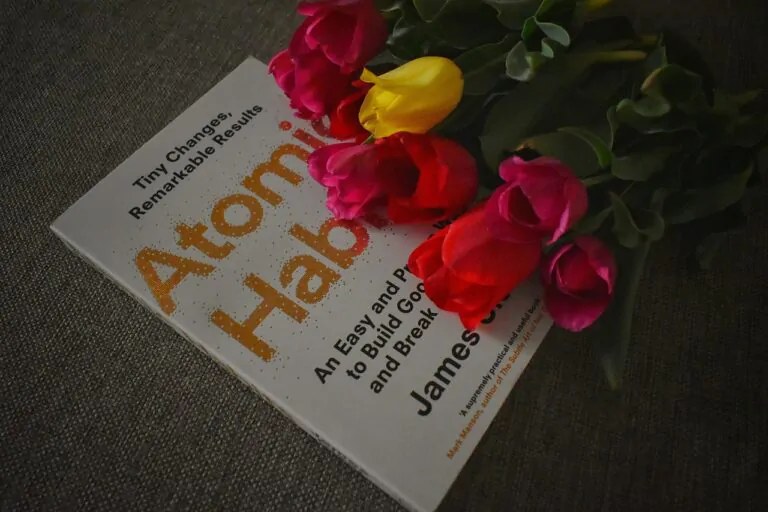
When I started reading The 5 AM Club, I had already finished Atomic Habits by James Clear. That book had made me think differently about habits—particularly about how small, consistent actions can eventually create remarkable change.

Then came Robin Sharma’s The 5 AM Club. For me, these two books connected almost perfectly. Atomic Habits helped me understand how habits are built. The 5 AM Club helped me think about where and when I could build them. So I decided to make 5 AM the starting point. Every morning, I opened the book at 5 AM. No matter which chapter I was reading, I respected the title of the book. Eventually, something interesting happened.
5 AM stopped feeling like an alarm time and started feeling like my personal time.
That, for me, was perhaps the biggest lesson of the book.
What is The 5 AM Club really about?
At first glance, The 5 AM Club sounds like a book about waking up early. It isn’t. At its heart, it is a book about personal mastery.

Robin Sharma uses a fictional story involving an entrepreneur, an artist and a mysterious billionaire mentor to introduce his philosophy of exceptional performance, discipline, creativity and purposeful living.
The central idea is simple:
Win the morning, and you create a better foundation for the day.
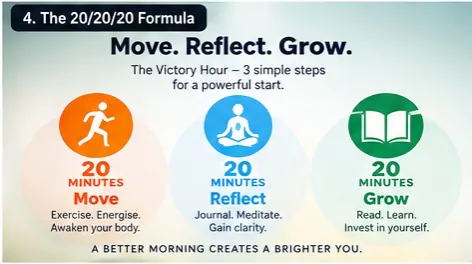
Sharma calls the first hour of the day the “Victory Hour.” His official description of the book centers on the 5 AM routine and the 20/20/20 Formula: Move, Reflect and Grow. The idea is to divide the first hour into three 20-minute blocks:
5:00–5:20 — Move
Exercise. Get your body moving. Sweat. Increase your energy.
5:20–5:40 — Reflect
Journal, meditate, think, pray or simply spend quiet time with yourself.
5:40–6:00 — Grow
Read, learn, study or develop yourself.
It is beautifully simple and perhaps that is why it is powerful.
“Move. Reflect. Grow.”
The 20/20/20 Formula became one of my favorite concepts from the book—not because it is complicated, but because it gives structure to an hour that could otherwise easily be wasted. Imagine starting your day with 20 minutes of physical movement, 20 minutes of reflection, and 20 minutes of learning.
Before you have even started your professional day, you have already invested in three important areas of yourself, your body, your mind, and your knowledge. That, for me, is a powerful shift in perspective. Sharma describes the 5 AM routine as a foundational habit that can influence and strengthen other habits in your life. This is also where my connection with Atomic Habits became even stronger: meaningful change doesn’t always begin with doing something extraordinary; sometimes, it begins with consistently dedicating a small part of each day to becoming a better version of yourself.
The science behind the morning
Of course, waking up at exactly 5 AM isn’t a magical formula that automatically makes someone successful. The real value lies in what you do with those early hours. Interestingly, modern research provides support for one important part of Sharma’s philosophy: exercise can benefit cognitive performance.

A 2025 umbrella review covering 133 systematic reviews, 2,724 randomized controlled trials and more than 258,000 participants found that exercise was associated with improvements in general cognition, memory and executive function.
Research has also specifically examined morning exercise. One study found that a morning bout of moderate-intensity exercise improved executive function or working memory and increased BDNF, a protein associated with brain health.
The biggest lesson I took from the book is that the early morning gives you something that has become increasingly rare in today’s busy world, uninterrupted attention. Before the emails start arriving, before meetings fill your calendar, before notifications begin demanding your attention, and before the expectations of everyone else take over your day, you have a precious hour that belongs entirely to you. An hour to pause, think, learn, reflect, and most importantly, work on yourself.
Atomic Habits was the foundation. The 5 AM Club felt like the cherry on top.
James Clear’s Atomic Habits changed the way I looked at behavioral change. Its core message is simple yet powerful: instead of obsessing only over big goals, focus on building the right systems and repeating small behaviors consistently. The 5 AM Club then gave me a practical environment in which to put that philosophy into action.

For me, 5 AM became the cue. Wake up. Get out of bed. Open the book. Read. Reflect. And start the day deliberately. What made this approach so effective was that I wasn’t trying to build ten new habits at once. I was simply building one powerful morning routine and allowing other positive habits to naturally attach themselves to it. Over time, waking up early became more than just a routine—it became a trigger for reading, reflection, learning and personal growth.
Perhaps my biggest personal takeaway from these two books together is this: you don’t always need more motivation to change your life; sometimes, you simply need the right cue, the right routine, and the consistency to repeat it every day.
That is perhaps my biggest personal takeaway from these two books together:
Build one strong habit that makes other good habits easier.
“All Change Is Hard at First…”
One of the lines from The 5 AM Club that stayed with me is: “All change is hard at first, messy in the middle and gorgeous at the end.” The more I thought about it, the more I realised that this isn’t really about waking up at 5 AM. It is about almost every meaningful change we try to make in our lives.
Whether it is starting to exercise, learning a new skill, developing a reading habit, changing our diet, becoming a better leader, building a business, writing consistently, or simply learning to become more patient—the beginning is rarely easy. We are excited at first, but soon reality sets in. Motivation fluctuates, routines get disrupted, and consistency becomes difficult. The beginning is uncomfortable, and the middle can be messy.
But if we stay with it long enough, something remarkable begins to happen. What once felt difficult slowly starts feeling familiar. We stop negotiating with ourselves. We don’t need as much motivation. We simply do it.
The difficult becomes normal.
And perhaps that is the real turning point—not when the behavior becomes effortless, but when we no longer have to think about doing it. That is when a behavior starts becoming a habit, and a habit starts becoming part of who we are.
What I Loved About the Book
What I loved most about The 5 AM Club is how it transforms something as ordinary as waking up into something deeply meaningful. The book doesn’t simply tell you to wake up early; it makes you pause and ask yourself a much more important question: What are you doing with the first hour of your life? That question stayed with me. Our mornings are often the only part of the day that hasn’t yet been taken over by emails, meetings, notifications, deadlines and other people’s priorities. How we choose to spend those first few moments can quietly influence the rest of our day, and perhaps even the direction of our lives.
Another aspect I genuinely appreciated was the book’s emphasis on recovery. Peak performance isn’t about constantly pushing harder, working longer or staying busy every minute of the day. Without adequate rest and recovery, even our best efforts eventually lead to exhaustion. This message feels especially relevant today, when being busy is often mistaken for being productive. The 5 AM Club challenges that mindset and reminds us that productivity isn’t about filling every minute of the day; it’s about deliberately investing some of those minutes in becoming better, physically, mentally and emotionally. Sometimes, the most productive thing we can do is pause, recharge and give ourselves the space to grow.
My biggest takeaways from The 5 AM Club

If I had to reduce the entire book to five lessons, they would be:
- Own your morning before the world owns your attention.
- Exercise is not only about physical fitness; it can also support cognitive health.
- Quiet time is productive time.
- Learning every day compounds.
- A powerful morning routine can become the foundation for other habits.
And perhaps my personal sixth lesson:
Don’t just read a book about change. Turn the book into an experiment.
But Should Everyone Wake Up at 5 AM?
This is where I would slightly disagree with taking the book too literally. 5 AM is not necessarily the right time for everyone. If waking up at 5 AM means sacrificing sleep, feeling exhausted throughout the day, or simply forcing your body into a routine that doesn’t suit you, then the whole purpose of the habit is defeated. The real lesson, in my view, isn’t about the number 5 on the clock. It is about intentionality, finding a consistent period of the day when your mind is relatively free from distractions, protecting that time, and using it to invest in yourself. For some, that might be 5 AM; for others, it could be 6 AM, 7 AM, or even a quiet hour in the evening. The time matters less than what you choose to do with it.

For me, that time became 5 AM. And something rather interesting happened because I was reading The 5 AM Club at 5 AM—I wasn’t merely reading about the habit; I was living it while reading about it. Every morning, the ideas in the book were no longer just concepts on a page. They were becoming part of my own experience. That made the book feel much more personal than an ordinary book review could ever capture. I wasn’t just reading about change; I was giving myself an opportunity to experience it.
Try Your Own 5 AM Experiment
My 7-Day “5 AM Club” Challenge for You
Instead of simply reading this review, nodding along, and moving on to the next article, why not turn the idea into a small personal experiment? You don’t have to wake up exactly at 5 AM or follow everything in the book. For the next 7 days, create your own version of the Victory Hour and see what happens when you deliberately give the first part of your day to yourself.
You could keep it beautifully simple: spend 20 minutes moving—walk, stretch, exercise or practise yoga. Then spend 20 minutes reflecting—ask yourself, What am I grateful for? What truly matters today? What could I improve? Finally, dedicate 20 minutes to growth—read a book, learn something new, develop a professional skill, or simply explore an idea that expands your thinking.
You don’t need to transform your life in seven days. Just give yourself one uninterrupted hour each day and observe the difference. Notice your energy. Notice your focus. Notice your thoughts. Most importantly, notice whether you begin to approach the rest of your day differently.

And here’s my challenge:
Don’t measure your success by how early you wake up. Measure it by how intentionally you begin your day.
After seven days, ask yourself:
- Did my mood change?
- Did I become more focused?
- Did I accomplish something important before the day became busy?
- Did I feel more in control of my time?
- Did one good morning habit trigger another?
And if you try it, I’d genuinely love to hear what happened. Because perhaps the real idea behind The 5 AM Club isn’t about joining a club of people who wake up at 5 AM. Perhaps it is about joining a much more important club:
people who choose to invest in themselves before the world starts demanding their attention.
Final Verdict: Should You Read The 5 AM Club?
Yes—but don’t read it simply as a book about waking up early. Read it as a book about personal leadership, intentional living and taking control of how you begin your day.
If your days often feel reactive, busy but unproductive, or dominated by everyone else’s priorities, this book offers a simple idea worth experimenting with: protect the first part of your day for yourself.

For me, the experience became especially personal. I didn’t just read The 5 AM Club—I read it at 5 AM, from the first page to the last. Somewhere along those quiet mornings, I realised I wasn’t simply reading about the habit; I was practising it.
Atomic Habits taught me the power of small, consistent behaviors. The 5 AM Club gave those behaviors a place to live. Together, they reinforced one simple idea:
A better life doesn’t always begin with a bigger goal. Sometimes, it begins with a better morning.
So tomorrow morning, ask yourself:
“What can I do in the first hour today that my future self will thank me for?”
Perhaps the goal isn’t to join the 5 AM Club.
Perhaps it’s to join a more meaningful club—people who deliberately invest in becoming a better version of themselves, one morning at a time.