AI and Critical Thinking: Are We Becoming Less Independent Thinkers?
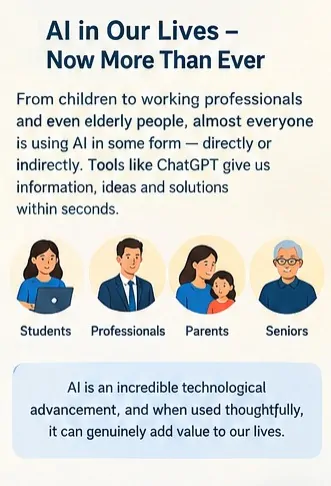
Artificial Intelligence has entered our lives at a speed unlike almost any technology before it. From growing children to working professionals and even elderly people, almost everyone is using AI in some form—directly or indirectly. Generative AI tools such as ChatGPT have made information, ideas and solutions available within seconds. This is an incredible technological advancement, and when used thoughtfully, AI can genuinely add value to our lives.
But every powerful technology comes with a responsibility. While we often discuss AI’s productivity benefits, there are other hidden costs that deserve our attention. The energy required to power data centres is growing rapidly, with the International Energy Agency projecting that global data-centre electricity consumption could roughly double from around 485 TWh in 2025 to about 950 TWh by 2030. AI is an important driver of this growth. Data centres also create local demands for cooling and water resources.
But there is another cost that concerns me even more personally: What happens when we start outsourcing not just our work to AI, but our thinking?
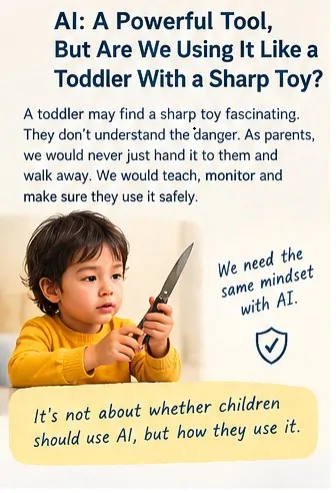
AI: A Powerful Tool, But Are We Using It Like a Toddler With a Sharp Toy?
I often think of AI as being similar to giving a sharp toy to a toddler.
A toddler may find the toy fascinating. They may play with it for hours because they don’t understand its potential danger. They don’t necessarily know how to use it responsibly or what could happen if they use it incorrectly. As parents, we would never simply hand a sharp object to a child and walk away. We would teach them, monitor them and make sure they understand how to use it safely.
I believe we need a similar mindset with AI.
The question isn’t whether children should use AI. They absolutely need to understand AI because it will be part of the world they grow up in. The question is how they use it.
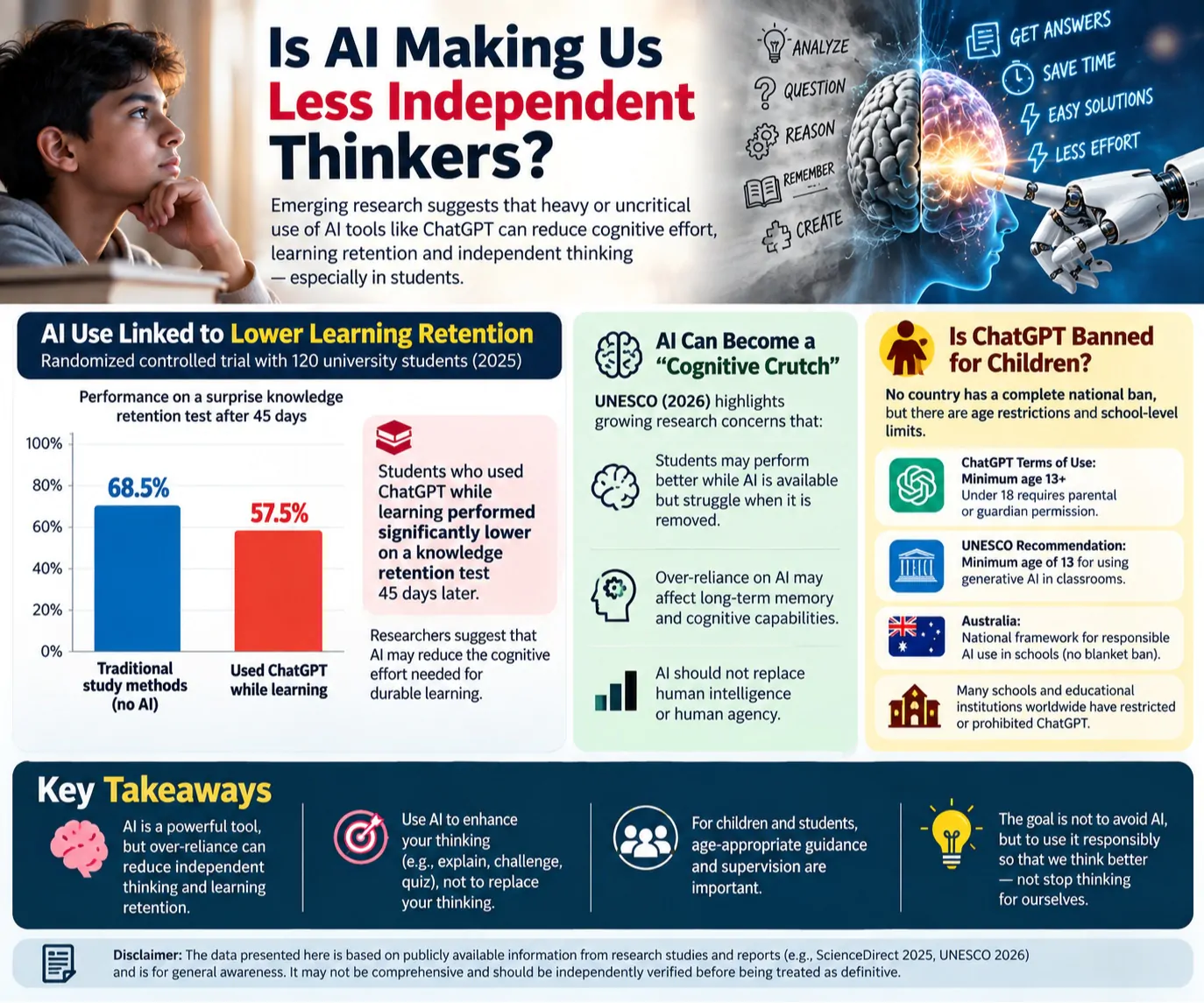
Recent research is beginning to raise exactly this concern. A 2025 randomized controlled trial involving 120 university students found that students who used ChatGPT while learning scored 57.5% on a surprise knowledge-retention test 45 days later, compared with 68.5% among students who used traditional study methods.
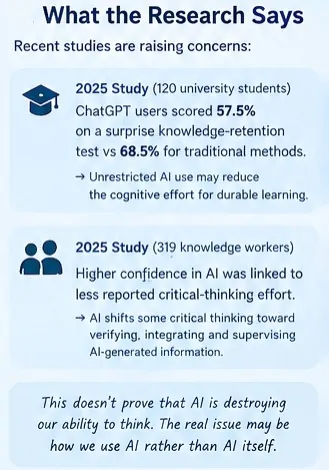
The researchers suggested that unrestricted AI assistance may reduce the cognitive effort required for durable learning.
Another 2025 study of 319 knowledge workers found that higher confidence in AI was associated with less reported critical-thinking effort. The researchers also found that AI changes the nature of critical thinking, shifting some of it toward verifying, integrating and supervising AI-generated information.
This doesn’t prove that AI is destroying our ability to think. The research is still evolving, and other studies have found that appropriately designed AI use can actually support analytical and reasoning skills. The real issue may therefore be how we use AI rather than AI itself.
Are We Taking Away the Very Exercises That Develop the Brain?
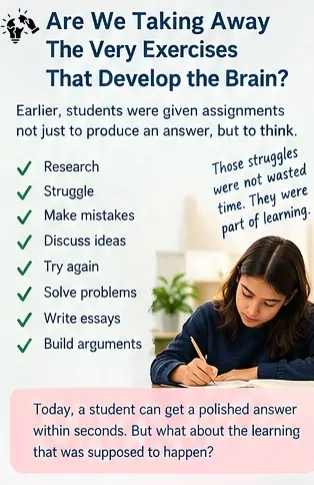
Think about how students traditionally learned.
They were given assignments not simply to produce an answer, but to think.
They researched. They struggled. They made mistakes. They discussed ideas. They tried again. They solved mathematical problems. They wrote essays. They developed arguments. They sometimes spent hours trying to understand why something wasn’t working.
Those struggles were not wasted time. They were part of the learning process.
Today, a student can potentially copy an assignment question into an AI tool and receive a polished answer within seconds.
The assignment may be completed—but what about the learning that was supposed to happen while completing it?
This is where I believe parents and educators need to pay attention.
UNESCO’s AI guidance advocates a human-centred and age-appropriate approach to generative AI in education, while its student AI competency framework specifically emphasizes critical judgement of AI outputs and responsible use of AI.
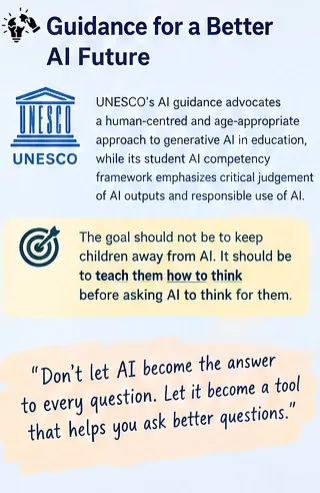

The goal should not be to keep children away from AI. It should be to teach them how to think before asking AI to think for them.
“Don’t let AI become the answer to every question. Let it become a tool that helps you ask better questions.”
What I Am Trying With My Own Kids
I have personally noticed my own children beginning to use AI even for tasks they are perfectly capable of completing themselves.
That made me think about something I had seen earlier with smartphones.
Many parents initially give smartphones to young children to keep them occupied while they work. Over time, however, excessive use can become difficult to control. What started as a convenient solution can become a habit that parents struggle to reverse.
I don’t want to repeat the same mistake with AI.
So instead of completely blocking AI, I have been experimenting with small habits.
One of them is digital detox. We started with longer intervals and gradually made them more frequent, including regular periods away from unnecessary digital consumption.
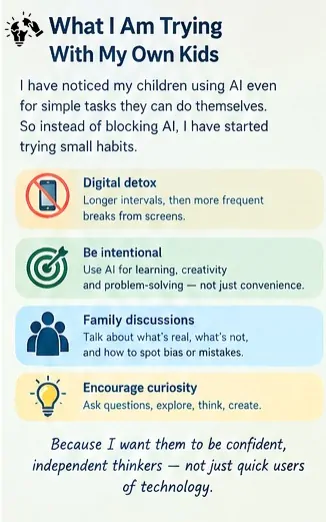
But there is one important rule: parents must practice what they preach. Children learn much more from what they see than from what they are told. If we tell children to reduce screen time while constantly looking at our own phones, the message loses its meaning. I also give my children certain assignments and encourage them to first think independently and then compare their answer with AI’s response.
Sometimes I even ask them to challenge AI.
“Can you prove that your answer is better than the AI’s?”
When they find a mistake in an AI response or develop a better argument themselves, I appreciate the effort.
It may sound like a small exercise, but I have seen how it builds confidence. One of the most effective things I’ve observed is spending dedicated time with kids, especially through bedtime stories, which help build their imagination.
The message is simple:
“AI can be intelligent, but your ability to think, question and challenge is still valuable.”
I See the Same Risk in Professionals Too
I have noticed something similar in professional life, particularly among software engineers.
I remember our engineering days when we were sometimes asked to dry run code—literally execute the logic manually in a notebook and work out the result.
It was painful at times.
But it was also excellent brain exercise.
Today, AI-assisted coding, no-code, low-code and other tools can dramatically accelerate development. I genuinely appreciate these technologies. But speed should not come at the cost of understanding.
I once observed an interesting incident involving an experienced software engineering team. The team had used AI extensively to build a complex application and successfully moved it into production. Everyone was happy.
Then the application suddenly crashed.
The team tried using AI prompts to troubleshoot the problem, but the issue involved complex business logic and application flow. AI could only work with the information it was given, and the team itself lacked a strong understanding of some of the underlying logic.
They eventually had to spend significant time understanding the code and tracing the application flow before finding the root cause.
The application had been built quickly.
But maintaining it required human understanding.
That experience reinforced an important lesson for me:
“AI can accelerate the creation of something, but it cannot replace the responsibility of understanding what we have created.”
I will explore AI and independent thinking among professionals in a separate article because that deserves its own discussion.
So, Should We Stop Using AI?
Absolutely not. AI is an extraordinary tool. The question is not AI versus human thinking.
The question is AI + human thinking versus AI without human thinking.
Use AI to explain something you don’t understand. Ask it to challenge your assumptions. Use it to generate alternative perspectives. Ask it to quiz you. Let it review your work after you have attempted it yourself.
But don’t make it your first response to every small problem.
Before asking AI, sometimes ask yourself:
“What do I think?”
Try solving the problem. Write your own answer. Make your own argument. Then ask AI to challenge it.
That small change can make a huge difference.
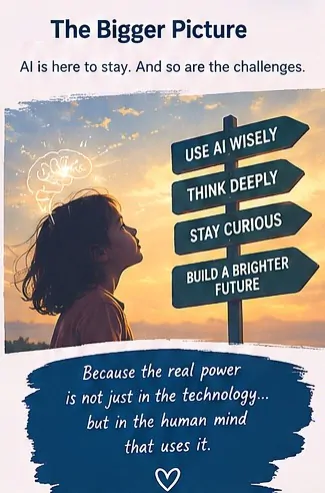
The future will not belong simply to people who know how to use AI. It will increasingly belong to people who know when to use AI—and when to think for themselves.
“The greatest danger is not that AI will think like humans. It is that humans may stop thinking because AI can.”
AI should be our thinking partner, not our thinking replacement.
And perhaps the most important responsibility lies with us as parents and educators: teach children to use AI without allowing AI to use their minds. It is equally essential for children to explore and develop other important life skills beyond technology, such as creativity, communication, problem-solving, empathy, and resilience.”
Note: The research on AI’s long-term effects on critical thinking and learning is still developing. Current studies show both potential risks and potential benefits depending on how AI is used. The examples and personal experiences shared in this article are my own observations and should not be interpreted as scientific evidence.
Practical AI Rules for Children: Teach, Don’t Just Restrict
The answer is not to completely ban AI from children. AI is going to be part of their education and future careers. Instead, parents can teach children how to use it without allowing it to replace their own thinking.
Here are some simple rules that can work at home:
1. Think first, ask AI later.
Before asking AI a question, encourage children to spend a few minutes thinking about it themselves. Even if their answer is incomplete or wrong, that thinking process is valuable.
2. Try it yourself before asking AI to do it.
For homework, coding, writing, mathematics, or problem-solving, children should make their own attempt first. AI can then be used to check, explain, or improve their work.
3. Never submit an AI answer without understanding it.
If AI provides an answer, ask your child: “Can you explain this in your own words?” If they cannot explain it, they probably haven’t learned it.
4. Make AI your teacher, not your homework machine.
Instead of asking, “Give me the answer,” encourage prompts such as: “Give me a hint,” “Explain where I went wrong,” or “Ask me questions so I can solve it myself.”
5. Challenge AI regularly.
Give children permission to disagree with AI. Ask them to find mistakes, missing information, weak arguments, or alternative solutions. This turns AI from an answer generator into a thinking partner.
6. Keep some AI-free learning.
Not every assignment needs technology. Reading a book, writing by hand, solving a problem on paper, drawing, building something, playing outdoors, or simply being bored can all give the brain valuable opportunities to think independently.
7. Create AI-free time every week.
A regular digital detox can help children experience activities without constantly reaching for a screen. It doesn’t have to be extreme. Even a few hours of technology-free family time can become a healthy habit.
8. Parents should follow the same rules.
Children notice what adults do more than what adults say. If parents use AI to answer every small question, write every message, plan everything, and solve every problem, children will naturally copy that behaviour. Showing children that we also think, read, question, and verify is one of the strongest lessons we can give them.
9. Protect curiosity.
Don’t make AI use a constant battle. Children should be allowed to explore and experiment with technology within reasonable boundaries. The goal is not to make them afraid of AI; it is to make them responsible users of it.
10. Ask one simple question: “What did you think?”
This may be the most important rule of all. After a child uses AI, ask them what they think about the answer. Their opinion, reasoning, doubts, and alternative ideas are often more important than the AI-generated response.
The goal is not to raise children who avoid AI. The goal is to raise children who can use AI without losing the ability to think without it.
What Do You Think?
So, I would genuinely love to hear from you.
As a parent, teacher, student or working professional:
Have you noticed AI changing the way you or your children think, learn or solve problems?
Do you encourage your children to use AI, restrict it, or try to find a balance?
Have you experienced a situation where AI helped you think better—or perhaps made you think less?
Share your experience in the comments. Your perspective might give another parent, educator or professional a completely new way of looking at this rapidly changing world.
Because perhaps the conversation we need is not “Should we use AI?”
It is:
“How can we use AI without losing the most human thing we have, the ability to think for ourselves?”